Down syndrome

Down syndrome, also known as Trisomy 21, is a congenital genetic condition. This condition is named after Dr John Langdon Down, who first identified its characteristics in 1866.
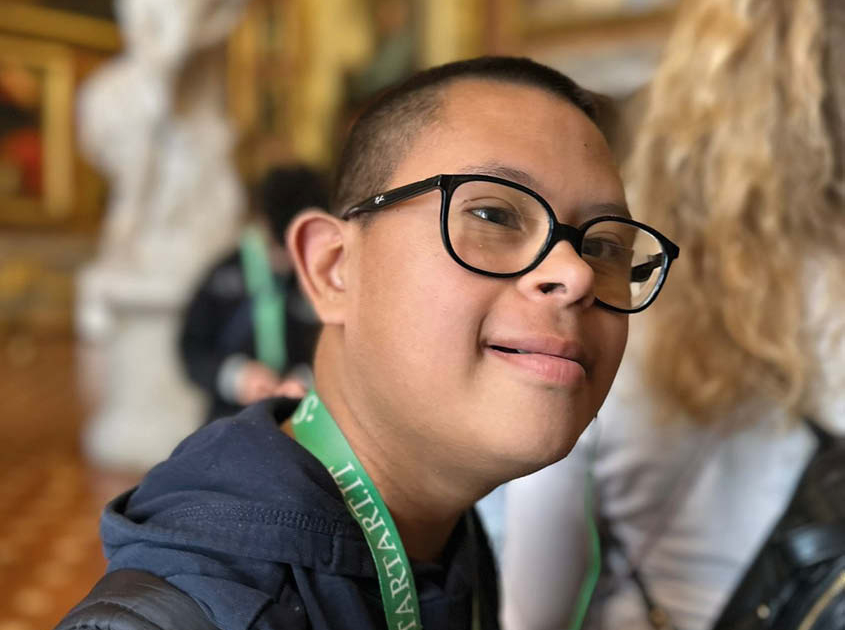
It is important to emphasise that Down syndrome is not a disease, but rather a genetic difference with which a person is born. Genetics does not mean hereditary; in fact, in 98% of cases, Down syndrome is not hereditary. This condition is characterised by the presence of an extra chromosome in chromosome pair 21, present in the body’s cells.
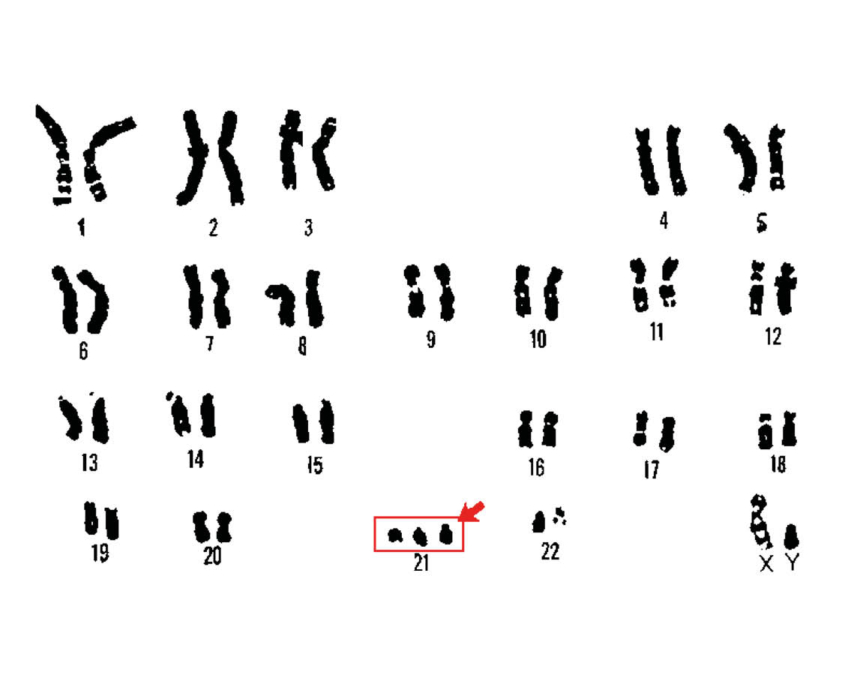
Image of chromosome pairs in Down syndrome, from pair 1 to pair 22. The image highlights the number 21, where an extra chromosome is marked.

Here’s how it works: all people are born with 46 chromosomes present in the nucleus of each cell, 23 + 23. These chromosomes are divided into 23 numbered pairs (chromosome pair 1, chromosome pair 2, chromosome pair 3, etc.), and each pair contains a parental element, one characteristic passed on by the father and one by the mother.

A person with Down syndrome is born with the same 46 chromosomes, but receives an extra one in chromosome pair number 21, thus arriving at 47 chromosomes. For this reason, the scientific name for Down syndrome is Trisomy 21.

The extra chromosome can affect a person’s physical, mental and motor development.
Frequently asked questions

Which are the chromosomal anomalies associated with Down syndrome?

In Down syndrome, there are three types of chromosomal anomalies but they all lead to a similar effect: an overproduction of chromosome 21 genes in organ cells.

The most common form is the Complete or Free Trisomy 21, which occurs in 95% of cases. In this condition, all cells in the body have three chromosomes 21 instead of two. This happens when the pair of chromosomes 21 does not separate correctly during the formation of germ cells.

Less frequently, Mosaic Down syndrome can be found, which occurs in 2% of cases. In this case, in the body of a person with Down syndrome, some cells have 46 chromosomes and others have 47 chromosomes. This anomaly occurs when the pair of chromosomes 21 does not separate correctly in the early divisions of fertilised egg cells.

Finally, there is a third, rarer form of anomaly called Translocation Trisomy 21, which occurs in 3% of cases. In this case, part of the extra chromosome 21 (or at least its terminal segment) is attached to another chromosome, usually number 14, 21 or 22.

How is Down syndrome diagnosed?

Down syndrome can be identified during pregnancy.
First and foremost, it is important to discuss these options with your doctor in order to make the best decision for your situation.

There are several ways to do this:

Amniocentesis and Villocentesis: These are medical tests that can be performed during pregnancy. Amniocentesis takes place around the 16th to 18th week of gestation, while villocentesis can be performed between the 12th and 13th week. During amniocentesis, a small sample of the amniotic fluid surrounding the foetus is taken. With chorionic villus sampling, cells that will develop into the placenta are taken. These tests are usually offered to women considered to be at risk (e.g., women over 37 or with a previous child with Down syndrome).

Triple test: This is a maternal blood test performed between the 15th and 20th week of pregnancy. It measures three substances in the maternal blood and, combined with the mother’s age, provides an estimate of the likelihood that the foetus has Down syndrome. However, it is important to note that the triple test is not a definitive diagnosis.

New techniques: New techniques are being studied that may be less invasive and safer. These techniques attempt to detect foetal cells in the mother’s blood or vagina.

What causes Down syndrome?

Despite extensive research, the specific causes of Trisomy 21 (such as chemical agents, radiation or infections) have not been confirmed.

Why are people with Down syndrome always happy?

People with Down syndrome are not always happy. Like everyone else, they experience a range of emotions.
Learning to recognise the complexity of a person, even when they have a disability, is a further step towards true inclusion.

Can people with Down syndrome work?

Absolutely!

Thanks to independence projects and partnerships with businesses (small, medium and large enterprises), people with Down syndrome can find employment and perform their jobs professionally.

Adults with Down syndrome

People with trisomy 21, from children to adults, have many vulnerabilities in communication, learning and relationships.

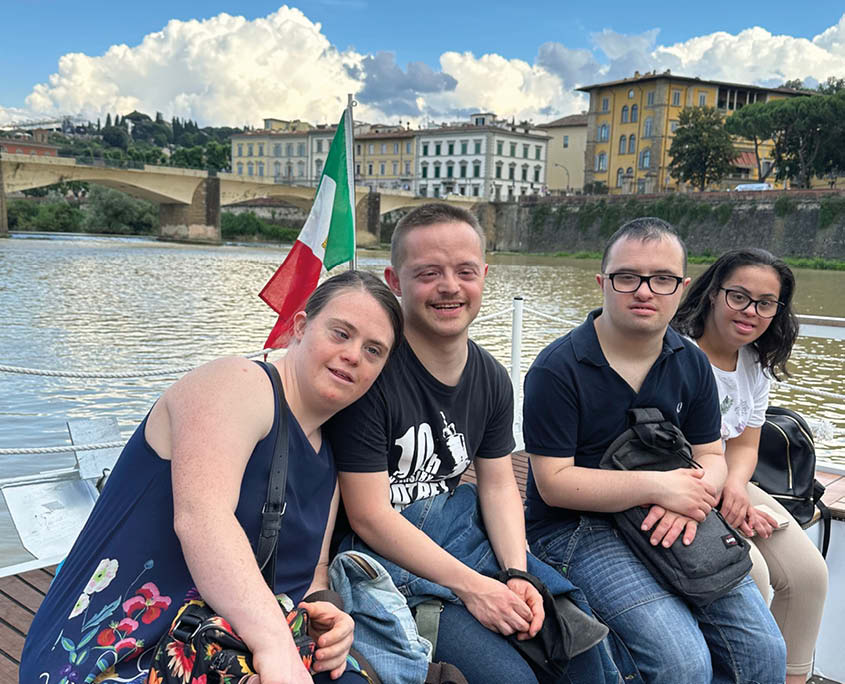
The photo shows a group of four adults with Down syndrome, two men and two women, during a boat trip.

For this reason, it is essential to provide them with the necessary support through targeted habilitation programmes, with the aim of developing their cognitive, adaptive and relational skills, thus enabling them to participate fully in social life.

A key element of this support and of our work is the Individualized Project for Life, which consists of an ongoing programme of habilitation activities designed to support the individual from childhood through to adulthood.

This programme also encompasses health, education, employment and leisure policies, thereby promoting genuine social inclusion.

Children with Down syndrome

Children with Down syndrome grow up achieving important milestones, even if perhaps at different times.

In rehabilitation, the goal is not only to compensate for difficulties, but rather to create an educational environment that promotes the child’s growth and development, exploiting their unique abilities and interaction with the world around them.

From a medical point of view, it is important to note that children with Down syndrome may have more specialist problems than their peers. These can include heart defects, intestinal problems, vision and hearing difficulties, thyroid dysfunction and dental problems.

It is therefore advisable to schedule regular health checks with your paediatrician to prevent or address any challenges in a timely and comprehensive manner.

The social inclusion of people with Down syndrome

Most people with Down syndrome can achieve a remarkable degree of personal independence. They can learn to take care of themselves, cook, run errands, and enjoy the outside world. They have the opportunity to play sports, make new friends, attend school, and learn to read and write.

Young people and adults with Down syndrome can learn a profession and become competent and productive professionals.

Although there are no precise statistics on the number of people with Down syndrome who work, there are many positive experiences thanks to the commitment of professionals and families.

People with Down syndrome are talented and have the potential to learn many skills. To fully realise these opportunities, it is essential that everyone learns to know them and trust their abilities.

Annual Report

Articles of Association

Privacy

Accountability for the 5×1000 scheme and public funding

5×1000 Funding

In accordance with the provisions set out in “Guidelines for reporting on the contribution of cinque per mille allocated to bodies in the third sector”, provision is made for the publication of the account and of the explanatory report on the contribution of 5 per mille.

Financial Year: 2023

Amount received: €29.172,64

Date of receipt: 27-12-2024

Rendiconto contributo 5×1000 2023 RND1243145983550329300.pdf

Fiscal Year: 2022

Amount received: €27.760,73

Date of receipt: 12-12-2023

Rendiconto contributo 5×1000 2022 RND1462122746996706300 (PDF)

Fiscal Year: 2021

Amount received: €24.627,81

Date of receipt: 16-12-2022

Rendiconto contributo 5×1000 2021 RND501117150613454720 (PDF)

Public funding received

In accordance with Article 1(125) of Law 124/2017, we hereby publish the list of public grants received during the year, broken down by calendar year.

We hereby notify, pursuant to Law 124/2017, Article 1, paragraph 125, the list of public grants received in the year 2024.

The total amount of grants was €90,918.64

View public funding received in 2024 (PDF in Italian)

In accordance with Article 1, paragraph 125 of Law 124/2017, we hereby publish the list of public grants received in 2023.

The total amount of grants received was €13,463.72

View public grants received in 2023 (PDF in Italiano)

In accordance with Article 1, paragraph 125 of Law 124/2017, we hereby publish the list of public grants received in 2022.

The total amount of grants received was € 41.101,00

View public grants received in 2022 (PDF in Italiano)

In accordance with Article 1, paragraph 125 of Law 124/2017, we hereby publish the list of public grants received in 2021.

The total amount of grants received was € 57.104,75

View public grants received in 2021 (PDF in Italian)

In accordance with Article 1, paragraph 125 of Law 124/2017, we hereby publish the list of public grants received in 2020.

The total amount of grants received was € 28.320,00

View public grants received in 2020 (PDF in Italian)

In accordance with Article 1, paragraph 125 of Law 124/2017, we hereby publish the list of public grants received in 2019.

The total amount of grants received was € 74.548,00

View public grants received in 2019 (PDF in Italian)

In accordance with Article 1, paragraph 125 of Law 124/2017, we hereby publish the list of public grants received in 2018.

The total amount of grants received was € 73.048,00

View public grants received in 2018 (PDF in Italiano)

Remuneration paid to directors, members of bodies of supervision, executives and partners

Grants paid

In order to ensure the transparency required by Article 14(2) of the Third Sector Code, we hereby disclose the remuneration paid each year to directors, members of the supervisory bodies, senior managers and members:

To ensure the transparency required by Article 14(2) of the Code of the Third sector. it is hereby announced that during course of 2024 the following remuneration was paid:

  • AUDIT BODY: €1,500.00 plus cash social security and VAT
  • TRUSTEES: no remuneration has been paid to them as Articles of Association the positions are unremunerated
  • MANAGEMENT: The Medical Director was paid €3,300.00, excluding VAT and pension contributions.
  • MEMBERS OF THE ASSOCIATION: no remuneration was paid to them.